
How to Search Civil Dockets
Warren County offers no anonymous civil name search. Circuit and County civil records sit behind the Ninth Circuit MEC/PAMEC route, and you reach them through the official Docket Report after registering. Chancery runs on a separate Ninth Chancery MEC system. For Justice Court civil cases, call the clerk at 601-634-6402 and ask about local search options.
Before searching, gather the initiating paper, the court name, and the full case number. Subject matter matters as much as the caption. A family, estate, guardianship, land, or equity filing belongs with Chancery, even when a general civil search feels more convenient.
- Classify the matter as Circuit, County, Justice, Chancery, or another local route.
- Use the complete court case number with authorized PAMEC/MEC access when the court participates.
- Ask the responsible clerk whether the latest setting replaced an earlier one.
- Request the exact pleading, order, or judgment when an electronic entry does not supply the paper.
- For an appeal or enforcement filing, ask whether a new number controls.
Warren Civil Docket Court Routing
Circuit Court serves as Warren's general civil venue outside another court's exclusive jurisdiction. The 2026 court directory sets County Court civil jurisdiction at up to $200,000. It puts Justice Court civil jurisdiction at up to $3,500. A proposal to raise the Justice Court figure never became law. That leaves $3,500 as the working line. Chancery takes divorce, custody, estates, probate, guardianship, conservatorship, land, equity, and commitments.
| Civil matter | First Warren court | Custodian or phone |
|---|---|---|
| General or larger civil action | Circuit Court | Circuit Clerk, 601-636-3961 |
| Claim within County Court jurisdiction | County Court | County Court office, 601-638-8026 |
| Claim within Justice Court jurisdiction | Justice Court | Justice Court clerk, 601-634-6402 |
| Family, estate, land, equity, guardianship | Chancery Court | Chancery Clerk, 601-636-4415 |
What a Civil Docket Shows
Warren's public interface shows no sample civil docket without logging in. That means header layout, party listings, attorney display, cause of action, dollar amounts, attachments, and entry names cannot be described in advance. One point holds regardless: the clerk keeps the docket and the filed papers, and the authorized system may issue a docket report for participating courts.
| Case number | Use the exact number from the initiating paper or notice; the research did not establish a Warren civil number format. |
|---|---|
| Court and clerk | Identify whether Circuit, County, Chancery, or Justice Court keeps the civil docket. |
| Dated entry | Can help narrow a request for a filing, process item, motion, order, or setting without claiming a fixed screen label. |
| Document request | Ask for the exact pleading, order, judgment, or other paper instead of assuming a docket view includes its image. |
| Case status | Read it with the latest dated entry and the controlling order, not as proof by itself. |
Warren Civil Docket PAMEC Access
PAMEC is the public-access layer for participating MEC courts. Its non-attorney terms list a $10 annual access charge plus $0.20 per result page, whether you view, print, or download it. Even a no-match search counts as a result page. Those charges cover only the electronic route, not clerk copy fees or certification. PAMEC's non-attorney terms spell out the conditions for a Warren civil docket account.
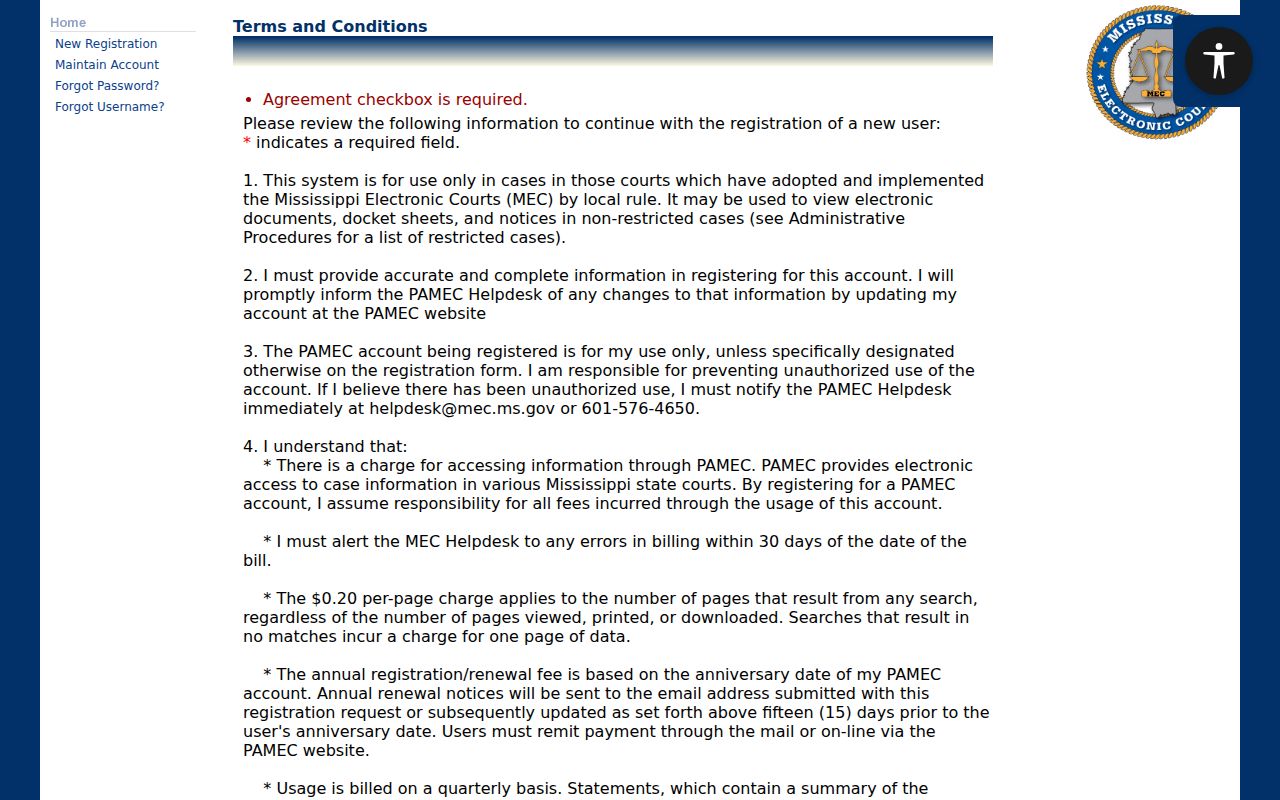
After an authorized search, save the case number and entry date. Then send any document request straight to the court's clerk.
Types of Civil Cases on the Docket
The same civil label can hide different docket custodians. A money claim may land in Justice, County, or Circuit Court. It depends on jurisdiction. Divorce, custody, paternity, estate administration, guardianship, conservatorship, title, partition, and other equitable claims all go to Chancery. That routing follows subject matter, not a party's preferred search term. The Chancery Clerk's duties describe the specialized records and docket work. Those files are kept apart from Circuit and County files.
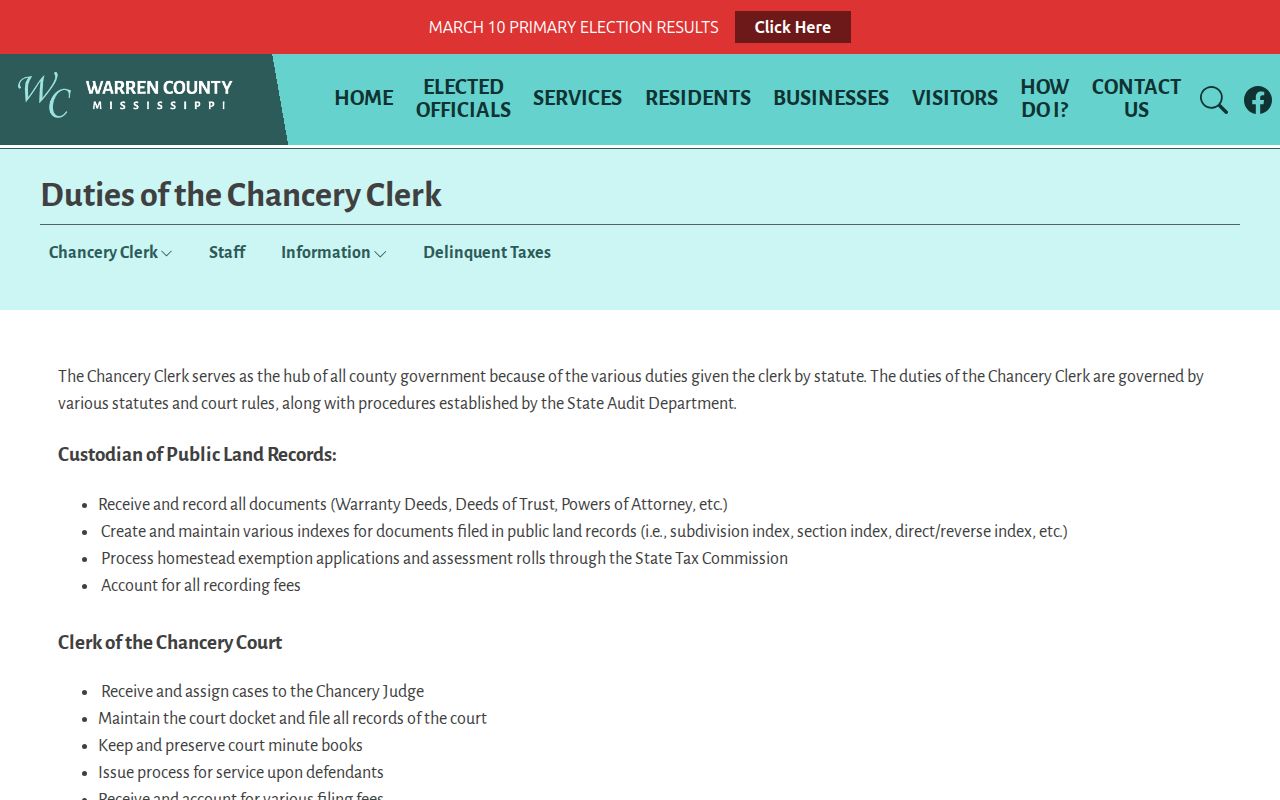
Classify the case before you search. That habit prevents mistaking a Chancery family or estate record for a general Circuit civil docket.
Warren Civil Docket Chancery Files
Warren's Chancery Clerk keeps the Chancery dockets, files, and minute books. For domestic-relations, probate, guardianship, land, equity, and commitment records, that office is the first call. Chancery shares a courthouse address with other courts. That does not turn a Chancery file into a Circuit file. Nor does it place Chancery in the same MEC system. The Warren County Chancery Clerk page is the official local source. It covers this separate civil docket route.
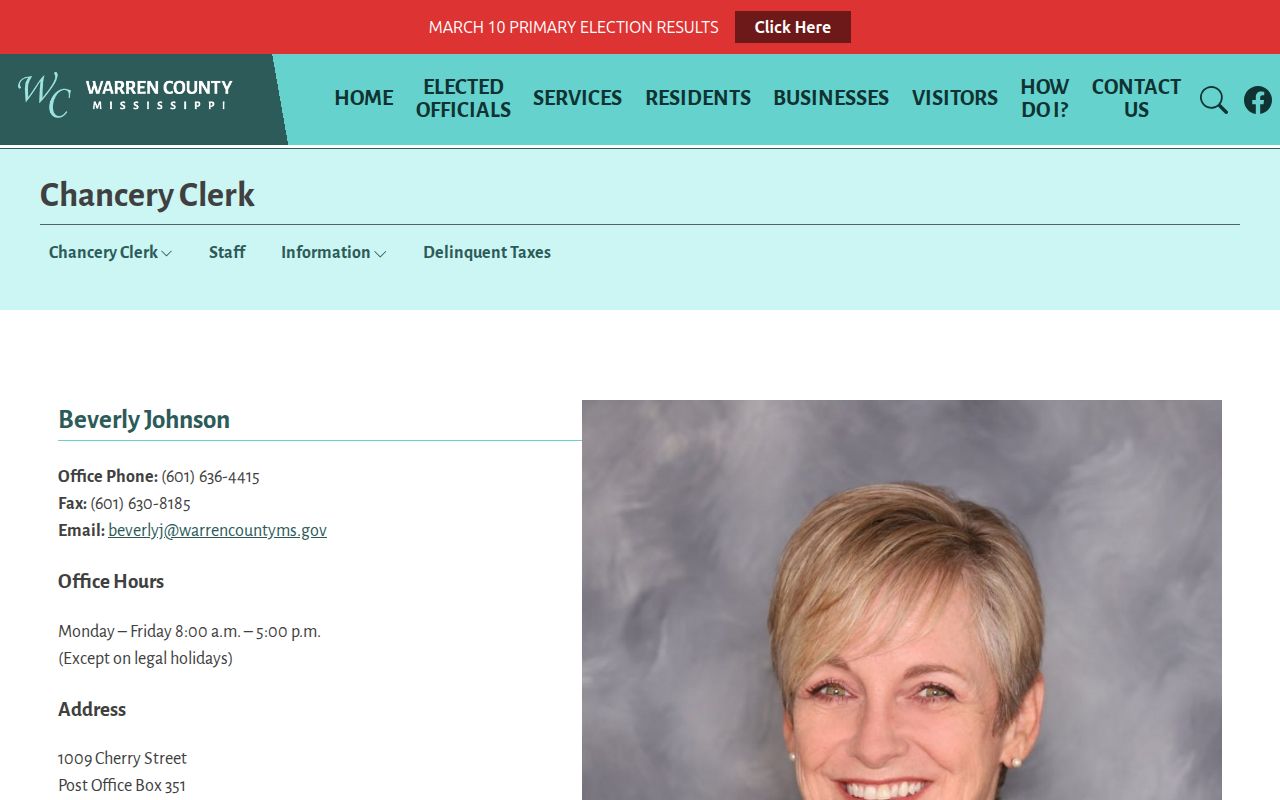
When asking the Chancery Clerk about inspection or copies, give the case number and the subject. Say whether it is an estate, a custody matter, or another Chancery issue, and the clerk can check the docket, minute-book item, or document.
Settings and Hearings on Civil Dockets
A civil case usually moves through familiar stages. Filing comes first. Then come process, response, motions and orders, a setting, judgment, post-judgment work, and sometimes an appeal. This describes the process generally, not exact Warren screen entries. Labels, courtroom fields, and document links should be confirmed through authorized access or the clerk.
Civil docket flow: filing › process › response › motions and orders › setting › judgment › post-judgment action › appeal.
Warren Civil Docket Chancery MEC
Warren County chancery cases live on a separate electronic system from the circuit clerk's docket. Through the Ninth Chancery MEC Court Information page, you can pull up Warren Chancery Court's entry directly. The page lists a MEC go-live date of April 7, 2010, marking the day electronic filing began for this court. Read that date with care. It tells you when the system started, nothing more. An older civil file may still lack a public image or even a searchable entry, so a gap in the docket does not mean the case never existed.
The Ninth Chancery MEC Court Information page is the official record of how and when Warren Chancery Court joined the electronic system.
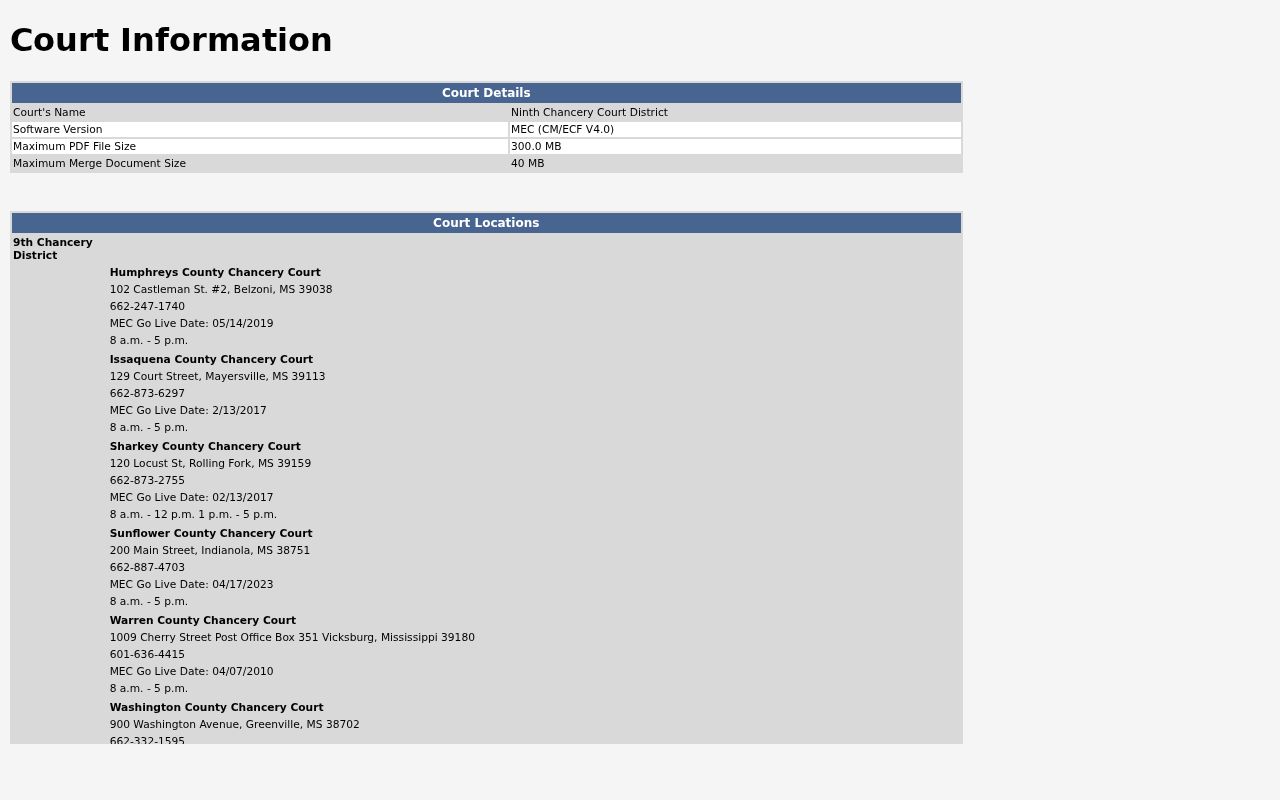
When an older or restricted Chancery document will not open, ask the Chancery Clerk. Never assume the docket holds no record just because the file resists electronic access.
Warren Civil Docket Account Paths
The public system splits its account paths between individuals and organizations. An account path changes nothing about record custody. Circuit and County cases stay with the Circuit Clerk. Chancery cases stay with the Chancery Clerk. Justice Court still runs through its own clerk. The organization screen confirms that the public-access system is an account service, not a countywide open search box. PAMEC's organization account page shows one of the registration paths tied to authorized Warren civil docket access.
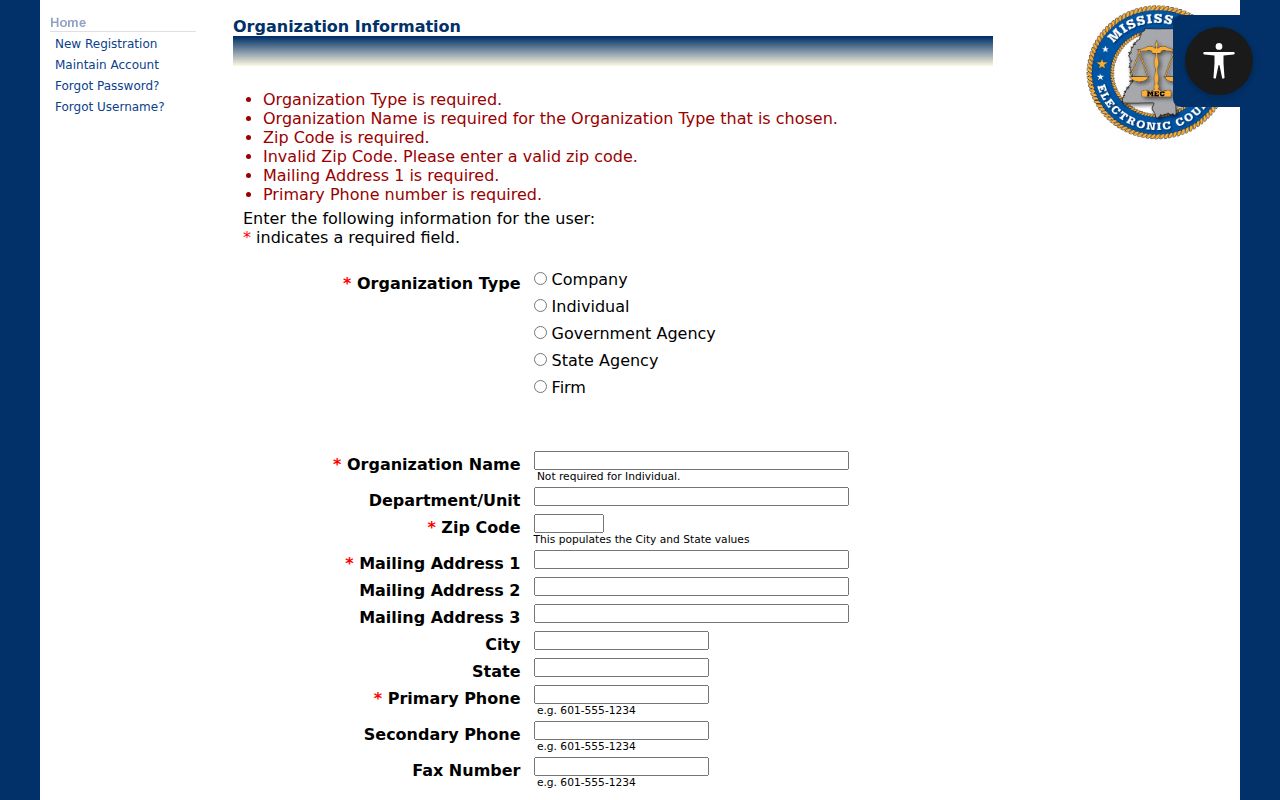
Know which court holds the file and have the exact case number in hand before you start an account search. That way the results route you to the office that actually keeps the Warren County civil record.
Warren Civil Docket No-Result Checks
A blank screen does not end the story. When an online lookup returns nothing, that alone proves no dismissal, no settlement, and no missing filing. The civil docket may sit in a different court. It may carry a different caption spelling, live only on paper, sit under an appeal number, or be restricted from view. A city warrant search cannot fill in for a Warren County civil docket search.
Check the paper caption and the court name first. Then call the clerk with the full case number. If a Circuit or County document stays invisible, build a narrow records request around the entry date and title. Chancery subjects belong with the Chancery Clerk, not the Circuit docket.
Warren Civil Docket Judgment Terms
Civil docket entries follow a shared vocabulary. Complaint, petition, process, response, motion, order, notice of setting, hearing, judgment, dismissal, default judgment, agreed judgment, nonsuit, appeal, and renewal are the terms worth learning. They reflect the clerks' duties and the county fee schedule, not a catalog of Warren docket codes. Keep three distinctions straight. A motion asks. An order rules. A judgment resolves.
The county fee schedule prices the paperwork: $6 for a judgment-roll entry or abstract of judgment, and $36 for a writ, garnishment, execution, judgment-debtor, or renewal service. A fee line does not prove any filing exists in your case. Ask the clerk which paper and number control.
Warren Civil Docket Request Details
When authorized access will not reach a Circuit or County document, the Circuit Clerk records-request form is the route. It needs the case number and a specific description of the record. It caps a request at five documents, starts research at $15 per hour, charges $1 per copy page, works on 14-day compliance wording, and asks for a self-addressed stamped envelope. Transcripts go to the court reporter instead.
Stage the request rather than asking for the whole civil file. Pull the docket sheet or judgment first. Once the docket shows a date and title, request that named pleading or order. For Chancery documents, ask the Chancery Clerk. Ask whether the file or a redacted public copy is available.
Public Access to Civil Dockets
Access turns on three things: the court, the document, and any restriction. Family, guardianship, conservatorship, custody, paternity, and domestic-abuse matters often carry restricted docket text. Blocked document images are common there too. A restricted result is not an invitation to work around it. Nor does it mean the case does not exist.
Use the proper access channel:
Mississippi Public Records Act information describes the state’s general public-record framework; court access is governed separately by judicial law and rule.
Mississippi judiciary public-records policy is the judiciary’s source on the openness and availability of court records.
MEC Administrative Procedures address restricted and sealed electronic filings.
Three questions settle most access puzzles. Ask the responsible clerk whether a redacted copy is public, whether a court order is required, and whether an appeal or post-judgment filing carries a new docket number.